Can Security Officers Detain a Shoplifter? UK Law Explained
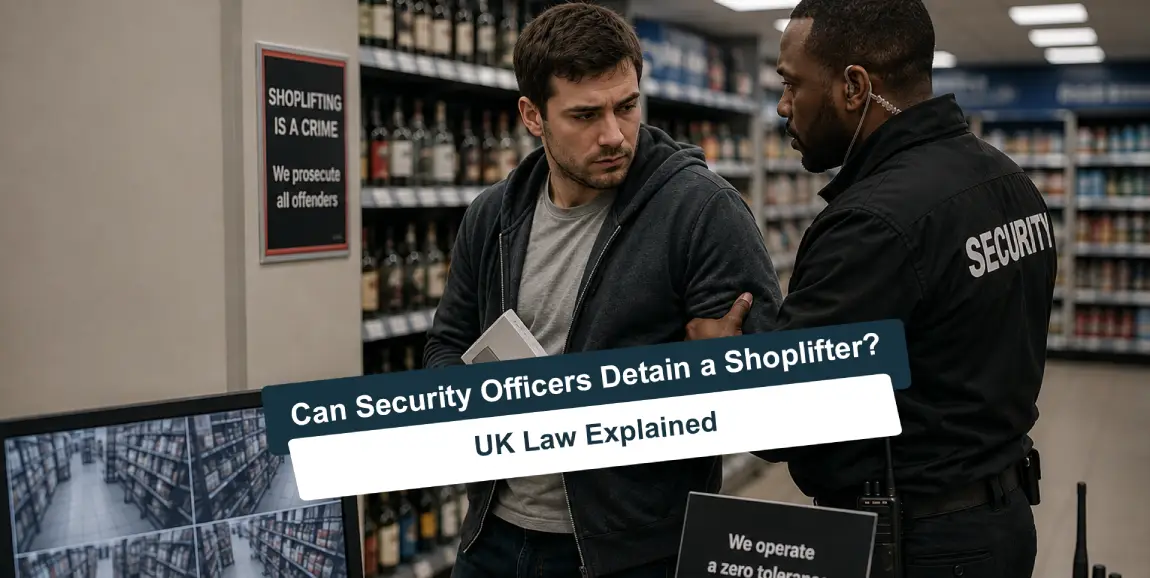
Can security officers detain a shoplifter? Yes, within limits. A security officer has the same power as any member of the public to make a citizen's arrest under section 24A of the Police and Criminal Evidence Act, and no more. This guide explains when that power applies, what reasonable force means, and the mistakes that turn a lawful stop into a complaint or a prosecution.
Can Security Officers Detain a Shoplifter? UK Law Explained
Yes. But four separate conditions have to be true at the same moment, and most officers can only name two of them.
Legislation checked against legislation.gov.uk and GOV.UK in September 2026. General guidance for security professionals, not legal advice on any individual incident.
A man walks past the last till with two bottles of spirits inside his coat. You watched him conceal them on camera four minutes ago. He is eight steps from the door.
Nobody else has noticed. Your radio is quiet. It’s on you.
What you do in the next twenty seconds decides whether this is a routine detention or a claim with your name on it.
Most officers know they are allowed to act. Far fewer could tell you what makes the action lawful. That gap is where careers end not through cowardice or laziness, but because nobody ever sat them down and drew the line. So here it is.
You have no special powers. None.
This surprises people, so read it twice. There is no authority that arrives with an SIA licence. When you detain a shoplifter, you are using the exact same power available to any shopper standing behind you in the queue: the “any person” arrest power under section 24A of the Police and Criminal Evidence Act 1984.
A store detective, a door supervisor, and a bloke buying milk all operate under identical legal authority. Your badge proves you were trained. In law it grants you nothing extra whatsoever.
Which means the four conditions below apply to you exactly as they apply to a member of the public and courts will judge you by them.
Four gates. Fail one, fail all.
Section 24A is not permission to stop people. It is a narrow test, and every gate has to open before you move.
1
The offence must be indictable. Theft from a shop clears this gate. Plenty of everyday summary-only offences do not.
2
You need reasonable grounds. You saw it, or you reasonably suspect it happened. A feeling, a look, or a previous ban is not reasonable grounds.
3
Police couldn’t realistically do it instead. This gate does more work than officers expect. If ringing 999 and waiting is genuinely realistic, your justification weakens fast.
4
The arrest must be necessary. To prevent injury to them or anyone else, to prevent loss or damage to property, or to stop them making off before police arrive.
One gate closed = unlawful detention. However guilty they turn out to be.
And one hard limit that catches people constantly: you cannot arrest for something that hasn’t happened yet. Certainty that somebody is about to steal gives you no power at all. Police can act on an anticipated offence. You cannot. Watch, record, and wait.
Three ways this goes wrong on a Tuesday
Rules are abstract. These are not. Every one of these happens weekly somewhere in UK retail.
UNLAWFUL
“He’s been in before”
You recognise him. He was caught lifting here in March and he’s banned. You stop him at the door with nothing in his hands and nothing on camera today.
History is not reasonable grounds. Gate 2 stays shut. What you have is a trespass issue for the manager, not an arrest.
UNLAWFUL
“Let’s have a look in the bag”
You’ve stopped someone lawfully, and now you want to see inside the rucksack to confirm it.
You have no power of search. You can ask. They can say no. That refusal changes nothing at all, and opening that bag without consent is an assault regardless of what falls out of it.
UNLAWFUL
“Wait in the office while I check the cameras”
Clean detention, correct grounds. Then you walk them to the back and hold them while you review footage and find a duty manager.
An arrest hands the person to police at the earliest practical moment. Holding them while you decide what you’d like to happen is false imprisonment, and it’s the version that produces the biggest payouts.
What the Crime and Policing Act 2026 changed and what it didn't
The Act received Royal Assent on 29 April 2026 and repeals the £200 “low-value shoplifting” rule. It has been widely reported as finally letting officers arrest for small thefts.
That reporting is wrong. The old legislation always preserved PACE arrest powers for low-value shop theft it specifically treated it as indictable so the power survived. What actually changes is where cases are tried and how heavily they can be sentenced, not whether you could detain anyone. The Act’s provisions also commence on separate dates, so check the current position before relying on it.
Force: what "reasonable" actually means
LAWFUL
Force that is reasonable in the circumstances
Section 3 of the Criminal Law Act 1967 allows it. Reasonable means no more than necessary and it gets judged afterwards, in daylight, by people who weren’t there and weren’t frightened.
UNLAWFUL
Anything beyond that
Excessive force brings a civil claim or a prosecution. And any conviction or caution lands with the SIA, where it becomes a licensing problem stacked on top of everything else.
The thing that kills people
Never hold anyone face-down. Never put weight on their back or chest.
Positional asphyxia is not a technicality from a training manual. It has killed people in UK retail and custody settings, and it kills fastest in exactly the population officers detain most: intoxicated, overweight, in mental health crisis, or simply exhausted from struggling.
Someone shouting is breathing. Someone who has gone quiet may not be. If you take nothing else from this article, take that.
Learn the line before you're standing on it
Our SIA courses cover lawful intervention, conflict management and the legal limits of your role taught by instructors who have actually worked the floor.
The escort that keeps everyone out of court
Once a lawful detention starts, the risk shifts from legal to physical. The safe procedure is deliberately unexciting:
- Call police first, not last. Establishing that a constable can’t attend quickly is part of your legal justification, not an afterthought.
- Say who you are and why. They must understand they’re being detained and what for.
- Two officers wherever possible. One talks, one watches. Lone detention is the highest-risk version of this job.
- Keep them upright and talking. Comfortable speech means clear airway.
- Stay somewhere visible and covered by cameras. Never a stockroom, never a blind corner.
- Record everything. Body worn footage, times, the exact words you used, who was present.
- Disengage the moment it escalates. Nothing on any shelf is worth a death or a prosecution.
That last one is a professional judgement, not a failure of nerve. Officers who understand it stay employable. Officers who don’t end up giving evidence.
A licence gets you hired. Training keeps you out of trouble.
An SIA licence proves you’re legally allowed to work. It doesn’t make you good at retail. The officers who handle detentions calmly and never see the inside of a witness box are the ones who topped up their licence with focused training.
London Security College runs CPD-certified online security courses covering exactly this ground, currently at half price:
| Course | Covers | Price |
|---|---|---|
| Retail Security Officer Awareness | Core duties and limits | £20 |
| Retail Shoplifting & Deterrence | Prevention before intervention | £20 |
| Conflict Management Awareness | De-escalation under pressure | £30 |
| Body Worn Camera Training | Lawful recording and evidence | £25 |
| Incident Report Writing | Statements that survive scrutiny | £30 |
Training a team? The Corporate & Retail Security Bundle packages six courses for £35 instead of £80. Moving toward surveillance work? The SIA CCTV course is the licensed route into control room roles.
The short version
You can detain a shoplifter. You do it under the same law as anyone else, and only when all four gates open at once. You cannot search anybody. You cannot act on what someone might be about to do. You cannot hold a person while you work out what you want.
Get any of that wrong and the person you stopped has a claim against you, whatever was inside their coat.
Twenty seconds isn’t long enough to work out the law. That’s why you learn it now, standing still, with a cup of tea so that when the man with the spirits reaches the door, you already know.
Read next: CCTV, shoplifting and retail security how evidence is lawfully gathered before any intervention begins.